Todays World News (@TodaysWorldNews) / Twitter

Showing posts with label South Korea. Show all posts

Saturday, February 4, 2017

Mattis: U.S. Will Defend Japanese Islands And Deploy Missile Defense In South Korea

Chinese officials reacted with disgust when Defense Secretary James Mattis announced Saturday the United States would defend Japan-controlled islands claimed by China and deploy missile defense in South Korea.
Mattis, according to The New York Times, told Japanese officials Saturday morning that the U.S. defense responsibilities of Japan expanded to the debated rocky station posts known as Diaoyu in China and Senkaku in Japan.
Mattis, who made his remarks at a Tokyo news conference, said that China’s territorial declaration to nearly all of its waters “has shredded the trust of nations in the region.” Sec. Mattis discussed Article 5 of the United States-Japan treaty, which obligates the the U.S. defend Japan or its territories that it controls against an attack.
China condemned the statement made by Mattis. The chief spokesman of China’s Foreign Ministry, Lu Kang, said in a statement on its website, “We urge the U.S. side to take a responsible attitude, stop making wrong remarks on the issue involving the Diaoyu islands’ sovereignty, and avoid making the issue more complicated and bringing instability to the regional situation.”
Read more: http://dailycaller.com/2017/02/04/mattis-u-s-will-defend-japanese-islands-and-deploy-missile-defense-in-south-korea/#ixzz4XlxgIT44
ASIA PACIFIC
China Assails U.S. Pledge to Defend Disputed Islands Controlled by Japanhttps://www.nytimes.com/2017/02/04/world/asia/china-us-jim-mattis-japan-islands.html?_r=0
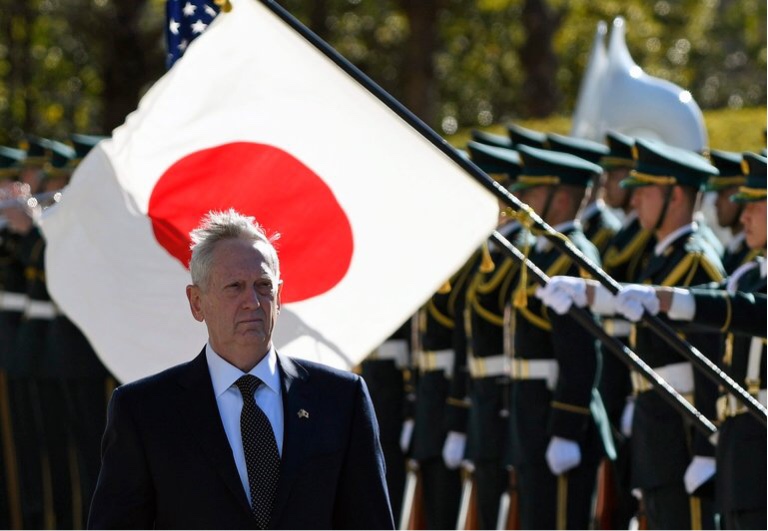
Defense Secretary Jim Mattis reviewed an honor guard before a meeting at the Defense Ministry in Tokyo on Saturday. Franck Robichon/European Pressphoto Agency
Last year, China sent a warship to within 24 miles of the islands. President Xi Jinping of China declared much of the East China Sea to be a Chinese air defense zone in 2013, and since then China has regularly sent fighter jets to patrol the area.
At a news conference in Tokyo, Mr. Mattis cited Article 5 of the United States-Japan treaty, which commits the United States to defend Japan or territories that it administers against attack.
“I made clear that our longstanding policy on the Senkaku Islands stands — the U.S. will continue to recognize Japanese administration of the islands,” Mr. Mattis said. “And as such, Article 5 of the U.S.-Japan security treaty applies.”
Before going to Japan, Mr. Mattis went to South Korea to offer assurances to that ally about defense commitments, and China’s reaction was similar.
No Extra Forces Needed in Gulf Now, Defense Chief Sayshttps://www.nytimes.com/2017/02/04/world/asia/jim-mattis-defense-iran-persian-gulf.html
TOKYO — Defense Secretary Jim Mattis described Iran as the world’s greatest sponsor of terrorism on Saturday, but he emphasized that there was no pressing need for the United States to beef up its military presence in the Persian Gulf region.
“I do not see any need to increase the number of forces we have in the Middle East at this time,” Mr. Mattis said, speaking in Tokyo at a news conference as he wound up his visits to Japan and South Korea, his first foreign trip as defense secretary.

Wednesday, March 9, 2011

North Korea jams Souths guided missiles - ABC News (Australian Broadcasting Corporation)

Teheran Ave in Gangnam-gu, Seoul, South KoreaImage via Wikipediahttp://www.abc.net.au/news/stories/2011/03/07/3156542.htm?section=world
North Korea has used sophisticated jamming equipment to block South Korean military signals and disrupt its guided missiles.
South Korea's Yonhap news agency is reporting that strong jamming signals were transmitted from the communist North last week.
The jamming is believed to have prevented some US and South Korean bombs from hitting their targets during a military drill
http://www.upi.com/Business_News/Security-Industry/2011/03/08/North-Korea-jams-Souths-guided-missiles/UPI-49341299621609/
SEOUL, March 8 (UPI) -- Seoul has accused North Korea of using sophisticated jamming systems to block South Korean military signals and disrupt its guided missiles.
South Korea's Yonhap news agency said the strong jamming signals have been transmitting from the northern border city of Keasong since last week.
The purported purpose of the jamming was to disrupt navigational devices using Global Positioning Systems as a major joint military exercise is under way northwest of Seoul.
The jamming is believed to have prevented some U.S and South Korean bombs from hitting their targets during a military drill. The Korea Communications Commission said they caused minor inconvenience last week.

Monday, February 28, 2011

North Korea threatens to attack South Korea, US

http://news.yahoo.com/s/ap/20110227/ap_on_re_as/as_koreas_clash;_ylt=AvGEaV0pHV.Tkw_nM10hUH6s0NUE;_ylu=X3oDMTNmZGFpcnNmBGFzc2V0A2FwLzIwMTEwMjI3L2FzX2tvcmVhc19jbGFzaARjY29kZQNtb3N0cG9wdWxhcgRjcG9zAzMEcG9zAzkEcHQDaG9tZV9jb2tlBHNlYwN5bl90b3Bfc3RvcnkEc2xrA25vcnRoa29yZWF0aA--
SEOUL, South Korea – North Korea threatened Sunday to enlarge its nuclear arsenal and "mercilessly" attack South Korea and the United States, as the allies prepared for joint military drills which the North considers a rehearsal for invasion.
North Korea routinely issues threats over the annual joint military drills, but its latest warning could rekindle tensions that rose sharply after two recent deadly incidents blamed on the North.
North Korea fired artillery at a front-line South Korean island in November, killing four people. Forty-six sailors died when a South Korean warship sank eight months earlier. North Korea has denied firing a torpedo at the ship.
North Korea called the South Korea-U.S. drills, which begin Monday, a "dangerous military scheme."
"The army and people of (North Korea) will return bolstered nuclear deterrent of our own style for the continued nuclear threat by the aggressors," North Korea's military said in a statement carried by the official Korean Central News Agency.
It accused South Korea and the U.S. of plotting to topple the North's communist government. It said if provoked, North Korea would start a "full-scale" war, take "merciless counteraction" and turn Seoul into a "sea of flames."
North Korea also warned it would take "our own missile striking action" against what it called moves by the U.S. and South Korea to eliminate the North's missiles. The statement didn't elaborate.
Earlier Sunday, the North's military warned that it would destroy South Korean border towns if Seoul continues to allow activists to launch propaganda leaflets toward the communist country.
Enhanced by Zemanta

Tuesday, November 30, 2010

N. Korea details nuclear program amid tension - World news - Asia-Pacific - msnbc.com

YEONPYEONG ISLAND, SOUTH KOREA - NOVEMBER 23: ...Image by Getty Images via @daylifehttp://www.msnbc.msn.com/id/40427485/ns/world_news-asiapacific
Secretive North Korea detailed for the first time its expanded nuclear program on Tuesday, saying it had thousands of working centrifuges, as pressure built on China to rein in its ally amid tensions on the peninsula.
Pyongyang's revelations about its uranium enrichment, which gives it a second route to make a nuclear bomb, came a week after it fired an artillery barrage at a South Korean island, killing four people including two civilians.
Although North Korean rhetoric remained high — the country warned the U.S.-South Korea military drills could trigger "full-blown war" — a senior North Korean official left Pyongyang for talks with leaders in China.

  1. Related content
    1. Newsweek: North Korea's new hard line
    2. McCain: Time to discuss N. Korea 'regime change'
    3. China proposes emergency talks on Korea crisis
    4. U.S., South Korea launch war games
    5. S. Korea commander vows retaliation
    6. NYT: Anxiety settles in Seoul after island attack
    7. NYT: From N. Korea, a pattern of aggression
Experts have voiced surprise at the sophistication of a uranium enrichment plant and light-water reactor at the North's main nuclear complex, which were shown to a U.S. scientist earlier this month.

Enhanced by Zemanta

Sunday, November 28, 2010

China proposes emergency talks on Korea crisis - World news - Asia-Pacific - North Korea - msnbc.com

YEONPYEONG ISLAND, SOUTH KOREA - NOVEMBER 23: ...Image by Getty Images via @daylifeGet ready folks this could very well become a major problem.

http://www.msnbc.msn.com/id/40401513/ns/world_news-asiapacific
China called for emergency talks on resolving a crisis on the Korean peninsula on Sunday, and Seoul and Tokyo said they would study the proposal, as the U.S. and South Korean militaries started a massive drill.
Beijing's move to bring the two Koreas to the negotiating table comes after global pressure on China to take a more responsible role in the standoff and try to rein in ally Pyongyang.
China made clear that the talks would not amount to a resumption of six-party disarmament discussions which North Korea walked out of two years ago and declared dead. South Korea said it would carefully consider China's suggestion.
  1. Related content
    1. U.S., South Korea launch war games
    2. Newsweek: North Korea's new hard line
    3. S. Korea commander vows retaliation
    4. South Korea orders more troops to front line
    5. China wary as U.S. warship heads to S. Korea
    6. N. Korea warns of retaliation; Seoul beefs up security
    7. NYT: Anxiety settles in Seoul after island attack
    8. Obama: U.S. will defend South Korea
    9. NYT: From N. Korea, a pattern of aggression
    10. South Korea considers asking for U.S. nukes
Both Beijing and Pyongyang have been pressing regional powers to return to talks, in some form or other, for the past few months, in a move analysts say is designed to extract concessions.
China, which agreed with South Korea that the situation was "worrisome," suggested the emergency talks for December among North and South Korea, host China, the United States, Japan and Russia. It did not say whether Pyongyang had agreed to join.
Japan was non-committal. "We want to respond cautiously while cooperating closely with South Korea and the United States," Kyodo news agency quoted Deputy Chief Cabinet Secretary Tetsuro Fukuyama as saying.
Beijing has longstanding bonds with Pyongyang, and has sought to shield its small, poor neighbor from a backlash that China fears could draw an even more ferocious reaction from North Korea and dangerously destabilize the region.

Critics in Washington and other capitals say China's approach amounts to coddling a dangerous nuclear-armed state.
Enhanced by Zemanta

Wednesday, November 24, 2010

Thanks, North Korea, for Reminding Us to Bomb Iran | The Blog on Obama: White House Dossier

Be sure to see the full article by Keith Koffler at the link below.

http://www.whitehousedossier.com/2010/11/23/north-korea-reminding-bomb-iran
by Keith Koffler on November 23, 2010, 11:29 am
If you want to have some idea what the world will look like once Iran gets nuclear weapons, have a look-see below. It’s our friend Kim Jong-Il, the Dear Leader, or his son, Baby Jerk, lobbing bombs at South Koreans on an island near the border.


So far, two South Korean soldiers have been killed, and more than a dozen soldier injured, along with a few civilians. The North Koreans can do this, because they have nuclear weapons. Here is why they have nuclear weapons:

That’s right, it was this guy who negotiated the “Agreed Framework” with North Korea in 1994 that gave them the cover to develop their uranium enrichment program.
So now North Korea gets to blow up South Korean ships – as they did in March, killing 46 sailors – and attack South Korean islands with impunity. Because there ain’t much we can do about it. Oh wait, maybe there are a few things.
Enhanced by Zemanta

Tuesday, November 23, 2010

North Korea bombs S. Korea

Korean Peninsula, showing North and South Kore...Image via Wikipediahttp://www.msnbc.msn.com/id/40329269/ns/world_news-asiapacific
South Korea warned North Korea on Tuesday of "enormous retaliation" if it took more aggressive steps after Pyongyang fired scores of artillery shells at a South Korean island in one of the most serious attacks on its neighbor since the Korean War ended in 1953.
The South fired back after Tuesday's attack and sent fighter jets to the area, close to a disputed maritime border on the west of the divided Korean peninsula and the scene of deadly clashes between the two rivals in the past.
South Korea was conducting military drills in the area at the time but said it had not been firing at the North. Pyongyang blamed Seoul for starting the fight, which killed at least two South Korean marines and wounded at least 15 other troops along with three civilians and razed scores of houses on the island of Yeonpyeong.

  1. Related content
    1. Newsweek: Attack signals hard-line policy shift
    2. NYT: From N. Korea, a pattern of aggression
Calling the incident "an invasion of South Korean territory," South Korean President Lee Myung-bak warned that future provocations could be met with a strong response, although there was no indication of immediate retaliation.


Enhanced by Zemanta

Tuesday, June 22, 2010

Abnormal radiation detected near Korean border

Nuclear weapon test Mike (yield 10.4 Mt) on En...Image via Wikipedia

  • read more on www.msnbc.msn.com
    SEOUL, South Korea - Abnormally high radiation levels were detected near the border between the two Koreas days after North Korea claimed to have mastered a complex technology key to manufacturing a hydrogen bomb, Seoul said Monday.
    The Science Ministry said its investigation ruled out a nuclear test by North Korea, but failed to determine the source of the radiation. It said there was no evidence of an earthquake, which follows an atomic explosion.
    On May 12, North Korea claimed its scientists succeeded in creating a nuclear fusion reaction — a technology necessary to manufacture a hydrogen bomb. In its announcement, the North did not say how it would use the technology, only calling it a "breakthrough toward the development of new energy."

  • read more on www.msnbc.msn.com

  • read more on news.yahoo.com
    On May 15, however, the atmospheric concentration of xenon — an inert gas released after a nuclear explosion or radioactive leakage from a nuclear power plant — on the South Korean side of their shared border was found to be eight times higher than normal, according to South Korea's Science Ministry.
    South Korea subsequently looked for signs of an artificially induced earthquake of a magnitude typically registered during a nuclear test. Experts, however, found no signs of such a quake in North Korea, a ministry statement said.
    "We determined that there was no possibility of an underground nuclear test," it said. The ministry said the gas is not harmful.

  • read more on www.military.com
    A U.N. official in Vienna, however, said no signs of increased radioactivity were detected last month along the Korean border by the Comprehensive Test Ban Treaty Organization, a U.N. agency that looks for signs of nuclear testing worldwide.

  • read more on www.military.com
    North Korea, which is believed to have enough weaponized plutonium for at least a half-dozen nuclear weapons, conducted two underground nuclear tests in 2006 and 2009, drawing international condemnation and U.N. sanctions.
    The news of the detected radiation comes as tension is running high on the Korean peninsula over the deadly sinking of a South Korean warship blamed on a North Korean torpedo attack. North Korea flatly denies the allegation and has warned any punishment would trigger war, as the U.N. Security Council reviews Seoul's request for action over the sinking

Enhanced by Zemanta

Wednesday, June 9, 2010

G20 countries shy away from global bank levy

Global Warming, Global Taxes, Global Government, and Global Banks?
If you have never read the Bible, You might want to start.
clipped from www.dw-world.de
US Treasury Secretary Timothy Geithner

The two-day G20 meeting of finance ministers and central bankers in Busan, South Korea concluded on Saturday, with no tangible initiatives to tackle the state of the global economy and banking regulation.

The meeting, which was designed to work out an agenda for the G20 summit in Toronto, Canada, at the end of the month, produced a communique that endorses the need for budgetary discipline and regulation of financial markets, but shies away from a global bank levy proposed by the International Monetary Fund (IMF), European countries, including Germany, and the US.

Canada and Australia are among those opposed to such a levy, as they believe they should not have to pay to clear up a mess they did not create.

German Finance Minister Wolfgang Schaeuble, however, insisted that regulating the banking industry must remain a global priority.

 blog it

Reblog this post [with Zemanta]

Tuesday, May 25, 2010

Text from North Korea statement

(Reuters) - North Korea announced on Tuesday it was cutting all ties with South Korea in retaliation for Seoul imposing sanctions on Pyongyang after torpedoing one of the South's warships.
clipped from www.reuters.com

The following are key points from the text of the report issued by the North's KCNA news agency.

"The Committee for the Peaceful Reunification of Korea, accordingly, formally declares that from now on it will put into force the resolute measures to totally freeze the inter-Korean relations, totally abrogate the agreement on non-aggression between the north and the south and completely halt the inter-Korean cooperation.

"In this connection, the following measures will be taken at the first phase:

"1. All relations with the puppet authorities will be severed.

"2. There will be neither dialogue nor contact between the authorities during (South Korean President) Lee Myung Bak's tenure of office.

"4. All communication links between the north and the south will be cut off.

"6. We will start all-out counterattack against the puppet group's 'psychological warfare against the north.'

"8. All the issues arising in the inter-Korean relations will be handled under a wartime law.

 blog it

Reblog this post [with Zemanta]

Monday, May 24, 2010

NKorea warns of war if punished for ship sinking

clipped from apnews.myway.com


SEOUL, South Korea (AP) - Tensions deepened Thursday on the Korean peninsula as South Korea accused North Korea of firing a torpedo that sank a naval warship, killing 46 sailors in the country's worst military disaster since the Korean War.


President Lee Myung-bak vowed "stern action" for the provocation following the release of long-awaited results from a multinational investigation into the March 26 sinking near the Koreas' tense maritime border. North Korea, reacting swiftly, called the results a fabrication, and warned that any retaliation would trigger war. It continued to deny involvement in the sinking of the warship Cheonan.

South Korea and the U.S., which has 28,500 troops on the peninsula, could hold joint military exercises in a show of force
"If the (South Korean) enemies try to deal any retaliation or punishment, or if they try sanctions or a strike on us .... we will answer to this with all-out war,"
 blog it

Reblog this post [with Zemanta]

US, SKorea to test military in signal to North

clipped from news.yahoo.com
Barack Obama

WASHINGTON — The Obama administration on Monday announced plans for two major military exercises off the Korean peninsula in a show of force aimed at North Korea, which has been blamed by investigators for a deadly torpedo attack on a South Korean warship.

The White House called U.S. support for South Korea "unequivocal" and said in a statement that President Obama had directed military commanders to work with the South "to ensure readiness and to deter future aggression."

North Korean leaders have denied responsibility and warned against any retaliation, but Secretary of State Hillary Rodham Clinton on Monday blamed the North for the crisis.

The sinking was South Korea's worst military disaster since the Korean War, which started 60 years ago and ended in a cease-fire in 1953. But no formal peace treaty was ever signed, and more than 28,000 U.S. troops remain stationed in the south, a critical regional ally.

 blog it

Reblog this post [with Zemanta]

Thursday, April 22, 2010

South Korean ship sunk by crack squad of 'human torpedoes'

clipped from www.telegraph.co.uk


A South Korean warship was destroyed by an elite North Korean suicide squad of
'human torpedoes' on the express orders of the regime's leader, Kim Jong-il,
according to military intelligence reports.

South Korean ship sunk by crack squad of 'human torpedoes'


The attack on the 1,220-ton Cheonan, which sank on March 26 with the loss of
46 of its 104 crew, was carried out in retaliation for a skirmish between
warships of the two nations' navies in November of last year, South Korea
claims.


The South Korean government has refused to comment officially on the reports
but Defence Minister Kim Tae Young told a parliamentary session that the
military believed that the sinking was a deliberate act by North Korea.


Officials in military intelligence say they warned the government earlier this
year that North Korea was preparing a suicide-squad submarine attack on a
South Korean ship.


"North Korean submarines are all armed with heavy torpedoes with 200kg
warheads," the source said.

 blog it

Reblog this post [with Zemanta]

Featured Post

The Truth about the Palestinian and Israeli conflict